Istanbul CCTV Drain Unclogging
With CCTV drain unclogging, Cantley sends a camera into the pipe, sees the blockage on a screen and does the clearing work by following that picture. A machine working on guesswork moves ahead without knowing where the blockage is or why it formed; the camera shows the team both the location and the cause. That means no breaking tiles, no opening walls and no repeating the same job several times, and you watch for yourself what is inside your pipe. Working from the image shows you clearly why and where the clearing is being done.

We use this method especially for stubborn and recurring blockages, for lines that run under walls or floors, and for pipes where earlier attempts to clear them have failed. The camera tells us whether the blockage is a layer of grease, a stuck object, or a root or crack that has entered the pipe. Each one is cleared in a different way, and choosing the right tool is the first condition for cleaning the line without damaging it. Working with a camera also helps at the end of the job, because the fact that the line is really clean is confirmed on screen.
When is CCTV unclogging needed?
A simple trap blockage does not need a camera. In the following situations, though, working by sight saves both time and unnecessary breaking.
If the same drain blocks again and again
A blockage that returns in the same place every few weeks points to a lasting problem inside the pipe that holds back waste. It could be a collapse, a protrusion or too little slope. The camera finds that point, and the clearing work goes straight to it.
If earlier attempts to clear it have failed
If the snake goes into the pipe and comes back, or will not advance past a certain point, you are dealing with a hard obstruction rather than an ordinary blockage. Forcing it blindly can break the pipe; with the camera we see what the obstruction is and choose the right tool for it.
If the blockage is inside the floor or a wall
If the line runs under a bathroom floor, a kitchen worktop or garden concrete, breaking in the wrong place turns into needless renovation. The camera shows how many metres in the blockage sits and, if needed, marks the spot to be opened with centimetre accuracy.
If sand, soil or root fragments come out of the drain
If soil, gravel or fine roots come out of the drain once it is cleared, material is getting into the pipe from outside at some point. In that case clearing alone is not enough; you need to see where the break is and decide how the line will be repaired.
If it is unclear which line is blocked
In older buildings where several pipes join, it is not always clear where the water comes from and where it goes. The camera follows the line from the inside, shows the connections and establishes exactly which branch the blockage is in.
What does the camera show inside the pipe?
The camera we use is a flexible cable with a lit, waterproof head at the tip. The cable is pushed into the pipe through the drain opening or an access cover, and it turns through bends as it advances. The picture from the head is sent live to the screen, and the marking on the cable tells us how many metres inside the camera is. Some heads also give off a position signal, so the exact location of the pipe can be found from above ground. Using this measurement, our team can tell which room, or even which tile, the blockage is under.
The types of blockage we see most often on screen are easy to recognise. On kitchen lines it is a yellowish layer of grease coating the pipe wall, on bathroom lines a clump of hair and soap, and on toilet lines a build-up of wet wipes and sanitary pads. In renovated buildings we see hardened plaster or cement at the bottom of the pipe, and in houses with gardens fine roots that have crept in through the joints. This picture directly decides which tool is best for the clearing work.
The camera shows the blockage and also the pipe itself. A cracked or crushed section, a slipped joint, a sagging stretch where water pools, or an old pipe narrowed by rust are all clearly visible on screen. This information lets us decide which tool to use and how much force to apply, and it prevents a fragile section from being damaged. The clearing is therefore done with a force the pipe can withstand, and the line takes no new damage.
How is clearing with a camera done?
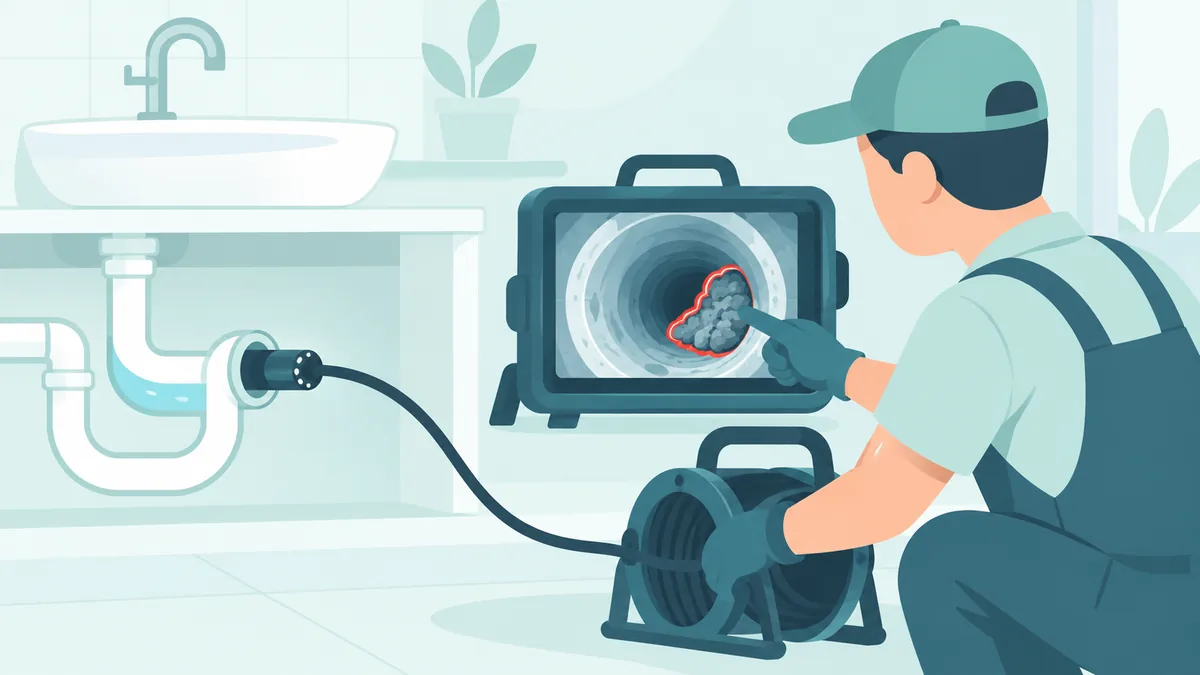
The camera starts as a diagnostic tool and stays on as a checking tool until the end of the job. The clearing work goes through four stages.
We send the camera down the line and find the blockage
We choose the most suitable entry point and advance the camera into the pipe. As soon as we see the blockage on screen, we note the measurement on the cable and, if needed, mark it above ground. You watch the screen with us and learn from the picture what is in the pipe. Meanwhile we also look over the pipe wall and the joints.
We choose the tool according to the type of blockage
There is a suitable method for each blockage: high-pressure water jetting for a layer of grease, a motorised drain snake for packed waste, a cutting head for roots. We also take the pipe's material and condition into account; on a cracked section we do not use a hard head, and we lower the pressure.
We watch the picture while clearing
Where suitable, we keep the camera in the line during the clearing work or send it back in at intervals. This way we see step by step how far the snake has broken up the blockage and how well the pressurised water has cleaned the wall. The risk of breaking and puncturing that comes with working blind is removed this way.
We show you the clean pipe
When the job is done, we run the camera through the line from start to finish one last time. We show you the cleaned pipe on screen and point out separately any crack or slipped joint that needs repair. That way you have seen that the job is really finished and can decide on the next step knowing where things stand.
Preparing before the team arrives
- Stop using the blocked line; as the water level drops, the camera sees the inside of the pipe and the blockage more clearly.
- If the line has an access cover, a manhole cover or an easily removed trap, show the team where it is.
- Make a short note of which methods were tried before and with what result; it is a valuable clue for the team.
- If you have used chemicals before, be sure to say so; the camera and the team will approach the pipe accordingly.
- If you have an old renovation plan or photographs of where the pipe runs, keep them ready.
Pictures from the field
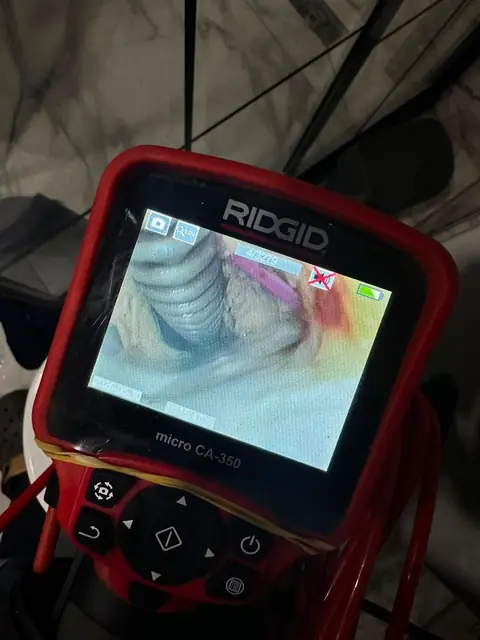
Build-up inside the pipe shown on the camera screen 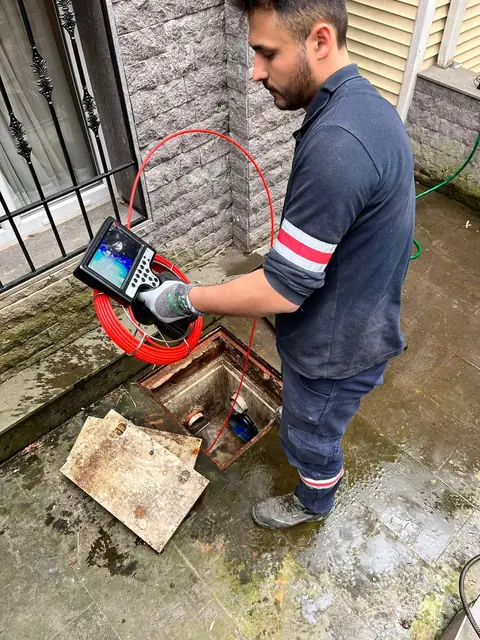
Watching the inside of the pipe on the camera screen at the manhole 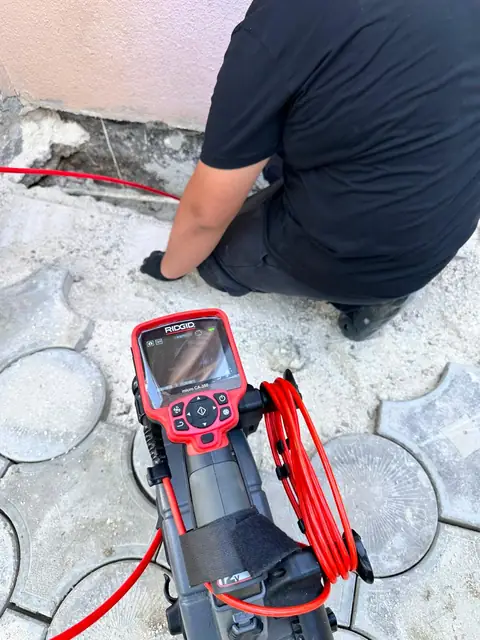
CCTV line check through a manhole in a paved area
CCTV Drain Unclogging by district
We provide this service in all 39 districts of Istanbul. Choose your district.
Frequently asked questions
What is CCTV drain unclogging?
CCTV drain unclogging means seeing the blockage with a camera sent into the pipe and doing the clearing work with the help of that picture. The camera shows the location and type of the blockage, and the team chooses a tool such as a snake or pressurised water to suit. The pipe is cleared without breaking and without guesswork. You can watch the picture along with us.
Where does the camera enter the pipe?
The camera enters through an opening the pipe already has. This can be a sink drain, a trap that has been removed, a toilet connection, an access cover or a manhole. Because the cable is flexible, it can turn through bends, so there is no need to open a wall or floor. We choose the entry point together, based on the structure of the line.
How does clearing with a camera avoid breaking the pipe?
Because the camera shows the exact location of the blockage, it largely removes the need to break anything. Even if the pipe really is damaged, the area to be opened stays limited to a small spot, based on the measurement in the picture. We also see the weak points of the pipe during clearing, so we work more gently there. This saves both time and unnecessary renovation.
Can I watch the camera picture too?
Yes, you can watch the picture live on screen together with the team. You see the blockage, the condition of the pipe and how it looks after cleaning with your own eyes. That way you clearly understand what is being done and why. If you wish, you can also take a screenshot of the important moments; this record helps when you plan a repair later.
Is clearing with a camera the same as sewer line inspection?
No, they are different services. In clearing with a camera, the camera is a helper used to clear a blocked line, and the job ends with the clearing. Sewer line inspection is a separate survey carried out to examine the condition of the line even when there is no blockage, and to document cracked or sagging sections. If you want the general condition of your line documented, you can request our survey service separately.
Our other services
No-Dig Drain Unclogging
We locate the blockage with a camera, then clear it with a drain snake and pressurised water. Your tiles stay where they are.
See detailsToilet Unclogging
From an overflowing toilet to the building's shared stack, we clear the toilet drain.
See detailsWashbasin Unclogging
Whether the blockage is in the trap or in the line inside the wall, we clear it cleanly.
See detailsKitchen Sink Unclogging
We jet the whole kitchen drain line with high-pressure water to remove built-up grease and starch.
See detailsCommercial Kitchen Drain Clearing
In restaurant and cafe kitchens, we clear the floor drain, grease trap and shared line without interrupting service.
See detailsShower and Bathtub Drain Unclogging
We clear the hair and soap that build up in floor drains, shower channels and bathtub drains.
See detailsBalcony Drain Unclogging
We clear balcony drains clogged with leaves, soil and sand before the rain arrives.
See detailsDrain Unclogging
We work out which drain is blocked, then clear the line in your home or workplace.
See detailsBlocked Drain Clearing
Is the blockage in the trap, the shared stack or the building outlet? We find it and show you the cause so it doesn't come back.
See detailsPVC Drain Pipe Unclogging
We clear PVC drain pipes without breaking anything, using heads that won't damage them.
See detailsPipe Unclogging
PVC, cast iron, galvanised or concrete pipe: we clear the blocked pipe with a head suited to its material.
See detailsManhole Unclogging
We clear the inlet and outlet lines of an overflowing manhole and get the flow moving again.
See detailsSewer Line Unclogging
We clear the building's main sewer line all the way to the street connection.
See detailsChannel Drain Unclogging
We use high-pressure water to clear garden lines, ramp and car park grates, and storm drains.
See detailsSewer Cleaning
We regularly clean out sludge, grease and root build-up with high-pressure water jetting.
See detailsSewer Camera Inspection
We find cracks, collapses and root intrusion with a CCTV drain camera and show you the footage.
See detailsSewer Line Renewal
We locate the damaged section with a camera and replace only the part that needs it.
See detailsBackflow Valve Installation
We keep water that comes back up from the street in heavy rain out of your basement and ground floor.
See detailsPVC Drain Pipe Replacement
We replace PVC drain pipes that are cracked, leaking or laid with the wrong fall.
See detailsVacuum Truck Service
24/7 pumping with combination and mini vacuum trucks for septic tanks, manholes, grease traps and flooded basements.
See detailsSeptic Tank Pumping
We empty full or overflowing septic tanks by vacuum and take the waste to an authorised disposal point.
See detailsSeptic Tank Cleaning
We clean the sludge at the bottom, the crust on the walls and the inlet and outlet pipes with high-pressure water.
See detailsCombi Vacuum Jetting Truck
One truck jets the line clean and vacuums out the sludge, for blocked main lines and full manholes.
See detailsMini Vacuum Truck
Our small truck gets into narrow streets, steep hills, courtyards and low garage entrances.
See detailsCar Park Vacuum Truck
We pump out an enclosed car park flooded after rain and clear the grate and ramp channels.
See detailsVacuum Truck Hire
We assign an operator-driven vacuum truck to construction sites, factories and housing complexes for scheduled or regular work.
See detailsPrivate Vacuum Truck Service
A vacuum truck for your own property that comes on your schedule, with no waiting in a queue.
See detailsVacuum Truck Company
A vacuum truck company that asks about the job over the phone, picks the right truck and transports the waste according to the rules.
See detailsLet us clear the blockage by sight
If you have a line that blocks often or cannot be cleared, call 0212 923 66 85 or write on WhatsApp. We look with the camera, show you the cause and clear the line without breaking. A photograph or a short video is also enough.