Istanbul Car Park Vacuum Truck
A car park vacuum truck service means pulling out the water that runs down the ramp after rain, the mud that settles on the floor and the waste that builds up in the grates, then leaving the area clean. At Cantley, our crew goes to underground car parks, basements and shelters in every district of Istanbul, every day of the week, day and night. With the vacuum tank and hose, water, mud and oily waste are collected without being dumped on the street.

In a car park, the job does not end with removing the water. After a downpour, sand, leaves, building debris and oil leaking from vehicles collect together and block the grates, and then the water rises again quickly. That is why pumping out the water and clearing the blocked channels should be handled in the same visit.
Which signs in a car park call for a vacuum truck?
Water left standing on the floor after the rain has stopped, smells coming from the grates or a full drainage sump are usually the signs that a crew is needed.
Water running down the ramp is not draining
If water is still sitting at the foot of the ramp or in low spots on the floor after the rain has stopped, the grate or the channel below it may be blocked. A submersible pump reduces the water to some extent, but it does not clear the mud on the bottom or the line itself, so the water rises again. In this case the water and the source of the blockage need to be removed together.
Thick mud left on the basement floor
Fine sand and mud left on the floor once the water is gone turn into smell and dust as they dry. You can sweep this layer up, but if the channel and the pit are at the lowest point, vacuuming gives a much cleaner result.
The water level in the drainage sump keeps rising
If the drainage sump in the basement or car park, that is the pump pit, keeps taking in water and the pump cannot empty it alone, mud has built up at the bottom of the sump. Until the mud is removed, the pump runs often, wears out its motor over time and fails.
Oily water and smell in the grates
Engine oil, brake dust and wash water that seep onto the floor from vehicles collect in the grate channels and form an oily layer. This layer causes smell and leads to blockages. Removing the oily waste and cleaning the channel first takes care of a large part of the blockage.
Low entrance or narrow ramp
In some car parks, the entrance height and the slope of the ramp do not allow a large vehicle to drive in. This makes it harder to run the hose in from outside. In such places we use a mini vacuum truck with a small chassis and park it at the safest point closest to the ramp entrance.
Water collects in the same spot after every downpour
If water pools in the same corner after rain, the problem is often more than dirt: the drainage line is not coping. In that case a one-off pump-out is not enough, and it is better to put the regular cleaning of the grates and channels on a schedule.
How does a car park vacuum truck job work, and which vehicle is chosen?
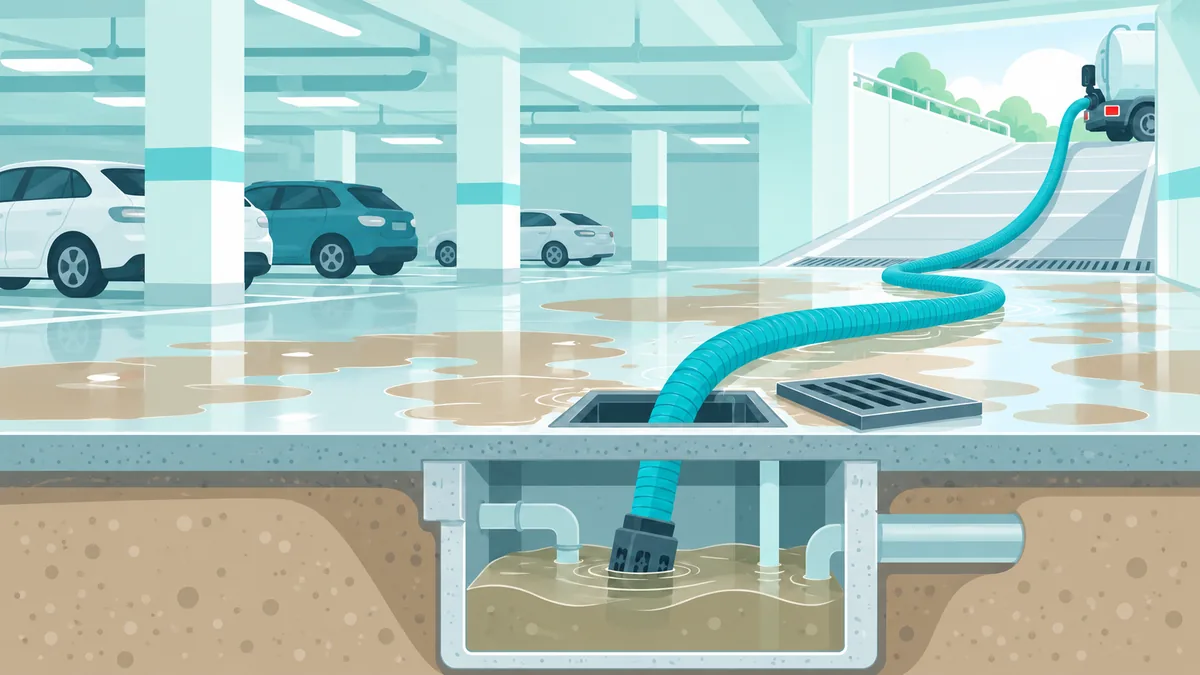
Water in an underground car park or basement involves two separate jobs. The first is emptying the water, and the second is clearing the mud from the grates and channels on the floor. The vacuum tank draws in the water and mud through the hose. The high-pressure water on our combination trucks loosens the mud stuck to the grate pits and channel walls. The loosened waste is drawn into the tank, and the rainwater is carried away without mixing into the street.
The vehicle is chosen according to the entrance and the amount of water. If the entrance suits it and there is a lot of water, we use a standard or combination truck. If the entrance is low or narrow, we prefer a mini vacuum truck. On the phone we ask about the entrance height, the slope of the ramp, where the vehicle can stop and how high the water has risen. Getting this information from the building management or the car park attendant makes the job easier. If you send photos of the entrance and the grates on WhatsApp, the decision can be made much faster.
The water and waste we remove are taken to authorised discharge points and licensed disposal facilities. Oily waste from vehicles goes to a facility suited to its type. Nothing is discharged into a storm drain, a stream or the sea. Do not hesitate to ask the crew you call where the waste is going, and we will tell you plainly.
We also plan regular maintenance for car park operators, site managements and shopping centres. Having the grates, the drainage sump and the main channels emptied once before the rainy season starts can reduce the number of emergency calls during downpours. With a hired or dedicated vacuum truck, we can set the crew aside for specific days and hours, and this arrangement suits clean-ups after a few weeks of renovation or construction work.
How does a car park vacuum truck service go, step by step?
Our aim is to remove the water safely, then leave the floor and channels ready for the next rain.
We talk through the entrance and the water level
When you call 0212 923 66 85 or write on WhatsApp, we find out the water level, how many floors the car park has and how the entrance is built. A flooded basement and a planned regular clean need different preparation, so we discuss how urgent it is from the start.
We send the right vehicle
Depending on the entrance, the ramp and the discharge point, we choose a combination, standard or mini truck, and we tell you why we chose it.
Safe parking spot and hose route
The crew parks the vehicle at the ramp entrance or the nearest safe point and lays the hose clear of the vehicle route and the pedestrian crossing. If needed, we mark the entrances temporarily.
We remove the water first
We start by drawing out the water that has collected on the floor and in the drainage sump. As the water level drops, the mud at the bottom of the area becomes visible.
We clean the grates and channels
We loosen the blocked grate pits, the oily layer on the channel walls and the mud at the bottom with high-pressure water and collect it with the vacuum. Once the mud in the sump has been removed, we check that the water level drops properly.
We wash the area and hand it back
When the pumping is done, we wash the places the hose passed through, the lower part of the ramp and the grate covers. The waste is taken into the closed tank and carried to the authorised point. We do not discharge it anywhere else.
What you can do before the crew arrives
- Do not touch sockets in the water or the electrical panel. If the panel can be reached without touching the water, switch off the relevant circuit.
- Move vehicles in the flooded area to a place where the water is not rising and which is not below the ramp.
- Tell the building management and the car park attendant that the crew is coming, and ask them to clear space for vehicle entry and exit.
- Remove leaves, bags and cardboard from the grates where the rainwater flows by hand, but do not step into the water.
- Do not try to lift heavy grate covers on your own. It is enough to show their location in a photo and pass it to the crew.
- If there are items in the basement, move the valuable ones and your documents to a dry floor.
Pictures from the field
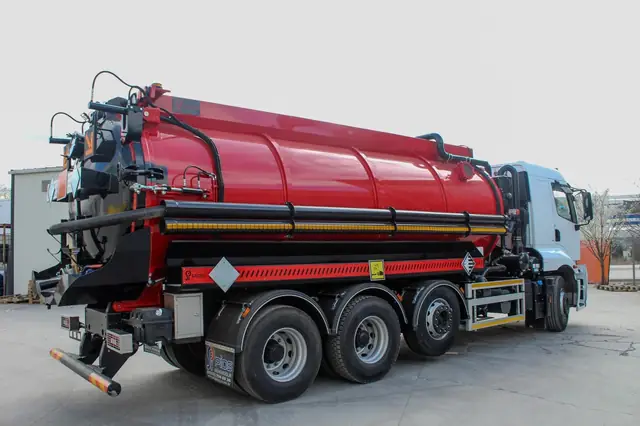
Rear view of the red vacuum truck 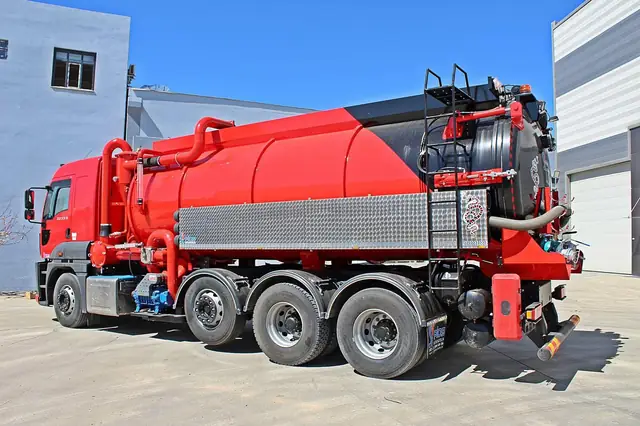
Side view of the red combination jetting and vacuum truck 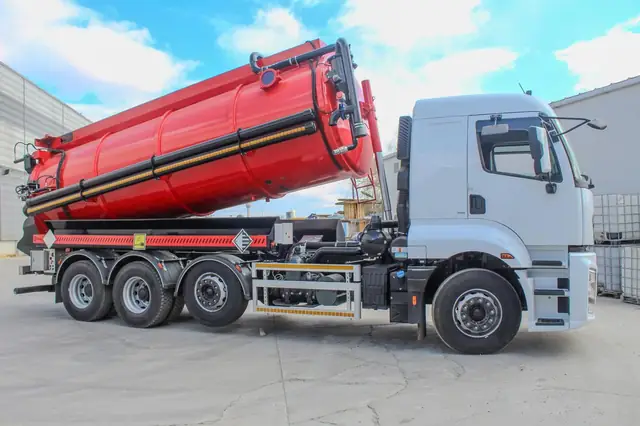
Red vacuum truck and its tank
Car Park Vacuum Truck by district
We provide this service in all 39 districts of Istanbul. Choose your district.
Frequently asked questions
What is a car park vacuum truck service?
A car park vacuum truck service means using a vacuum vehicle to remove rainwater, mud and oily waste that have collected in underground car parks and basements, and then cleaning the floor. On our combination trucks, pressurised water loosens the grates and channels, and the vacuum collects the loosened waste.
What should I do if my car park floods after rain?
First check the sockets and panels the water has reached, and do not step into the water. Then call us for a car park vacuum truck and tell us the entrance height and the water level.
Can a vacuum truck get into a car park with a low ceiling?
Yes, we use a mini vacuum truck for low entrances and narrow ramps. If the vehicle cannot get in, we park at the nearest safe point and run the hose along the ramp. Telling us the entrance height and the slope of the ramp on the phone lets us choose the right vehicle.
Why do car park grates get blocked?
Sand, leaves and small litter brought in by downpours, along with oil and brake dust leaking from vehicles, collect in the grate pits. Over time this mixture forms a hardened layer in the channel and slows the flow of water. Cleaning the grates before going down into the channel is an important part of the job.
When should a drainage sump be emptied?
A sump needs emptying if its water level rises with every rain, or if the pump runs often and struggles to empty the water. In a muddy sump the pump works harder and fails over time. Having it cleaned once before the rainy season starts is the soundest approach.
Is the oily water in the car park also removed?
Yes, oily water and mud that seep onto the floor from vehicles are treated as a separate waste and removed. Oily waste is taken to a licensed facility suited to its type. If the oil separator and the grate pits are not cleaned regularly, smell and blockage problems grow.
How is regular cleaning planned for sites and shopping centres?
First we work out how many grates, drainage sumps and main channels there are and which one collects the most water. Then a first pump-out is done before the rainy season, and afterwards we discuss the interval according to how heavily the car park is used.
What decides the scope of a car park vacuum truck job?
The scope of the job is decided by the amount of water, access to the discharge area, the type of waste and the distance to the point where it will be taken. After getting this information on the phone, we explain plainly what will be done.
Our other services
No-Dig Drain Unclogging
We locate the blockage with a camera, then clear it with a drain snake and pressurised water. Your tiles stay where they are.
See detailsToilet Unclogging
From an overflowing toilet to the building's shared stack, we clear the toilet drain.
See detailsWashbasin Unclogging
Whether the blockage is in the trap or in the line inside the wall, we clear it cleanly.
See detailsKitchen Sink Unclogging
We jet the whole kitchen drain line with high-pressure water to remove built-up grease and starch.
See detailsCommercial Kitchen Drain Clearing
In restaurant and cafe kitchens, we clear the floor drain, grease trap and shared line without interrupting service.
See detailsShower and Bathtub Drain Unclogging
We clear the hair and soap that build up in floor drains, shower channels and bathtub drains.
See detailsBalcony Drain Unclogging
We clear balcony drains clogged with leaves, soil and sand before the rain arrives.
See detailsDrain Unclogging
We work out which drain is blocked, then clear the line in your home or workplace.
See detailsBlocked Drain Clearing
Is the blockage in the trap, the shared stack or the building outlet? We find it and show you the cause so it doesn't come back.
See detailsPVC Drain Pipe Unclogging
We clear PVC drain pipes without breaking anything, using heads that won't damage them.
See detailsPipe Unclogging
PVC, cast iron, galvanised or concrete pipe: we clear the blocked pipe with a head suited to its material.
See detailsCCTV Drain Unclogging
We look inside the pipe together on a screen and clear the blockage exactly where it is.
See detailsManhole Unclogging
We clear the inlet and outlet lines of an overflowing manhole and get the flow moving again.
See detailsSewer Line Unclogging
We clear the building's main sewer line all the way to the street connection.
See detailsChannel Drain Unclogging
We use high-pressure water to clear garden lines, ramp and car park grates, and storm drains.
See detailsSewer Cleaning
We regularly clean out sludge, grease and root build-up with high-pressure water jetting.
See detailsSewer Camera Inspection
We find cracks, collapses and root intrusion with a CCTV drain camera and show you the footage.
See detailsSewer Line Renewal
We locate the damaged section with a camera and replace only the part that needs it.
See detailsBackflow Valve Installation
We keep water that comes back up from the street in heavy rain out of your basement and ground floor.
See detailsPVC Drain Pipe Replacement
We replace PVC drain pipes that are cracked, leaking or laid with the wrong fall.
See detailsVacuum Truck Service
24/7 pumping with combination and mini vacuum trucks for septic tanks, manholes, grease traps and flooded basements.
See detailsSeptic Tank Pumping
We empty full or overflowing septic tanks by vacuum and take the waste to an authorised disposal point.
See detailsSeptic Tank Cleaning
We clean the sludge at the bottom, the crust on the walls and the inlet and outlet pipes with high-pressure water.
See detailsCombi Vacuum Jetting Truck
One truck jets the line clean and vacuums out the sludge, for blocked main lines and full manholes.
See detailsMini Vacuum Truck
Our small truck gets into narrow streets, steep hills, courtyards and low garage entrances.
See detailsVacuum Truck Hire
We assign an operator-driven vacuum truck to construction sites, factories and housing complexes for scheduled or regular work.
See detailsPrivate Vacuum Truck Service
A vacuum truck for your own property that comes on your schedule, with no waiting in a queue.
See detailsVacuum Truck Company
A vacuum truck company that asks about the job over the phone, picks the right truck and transports the waste according to the rules.
See detailsTell us about your car park entrance
For a flooded car park, a basement or an area with overflowing grates, call 0212 923 66 85 or write on WhatsApp. We listen to the details of the entrance and the water level, then send the right vehicle. Our crew reaches every district, day and night.