How to Unclog a Blocked Pipe
A blocked drain pipe can often be cleared with a flexible hand snake fed in through the trap connection or an access point. First work out whether the blockage affects a single drain or the shared line. If water rises from other drains, the blockage keeps coming back or the pipe is old cast iron, it needs a camera inspection and clearing with a machine.
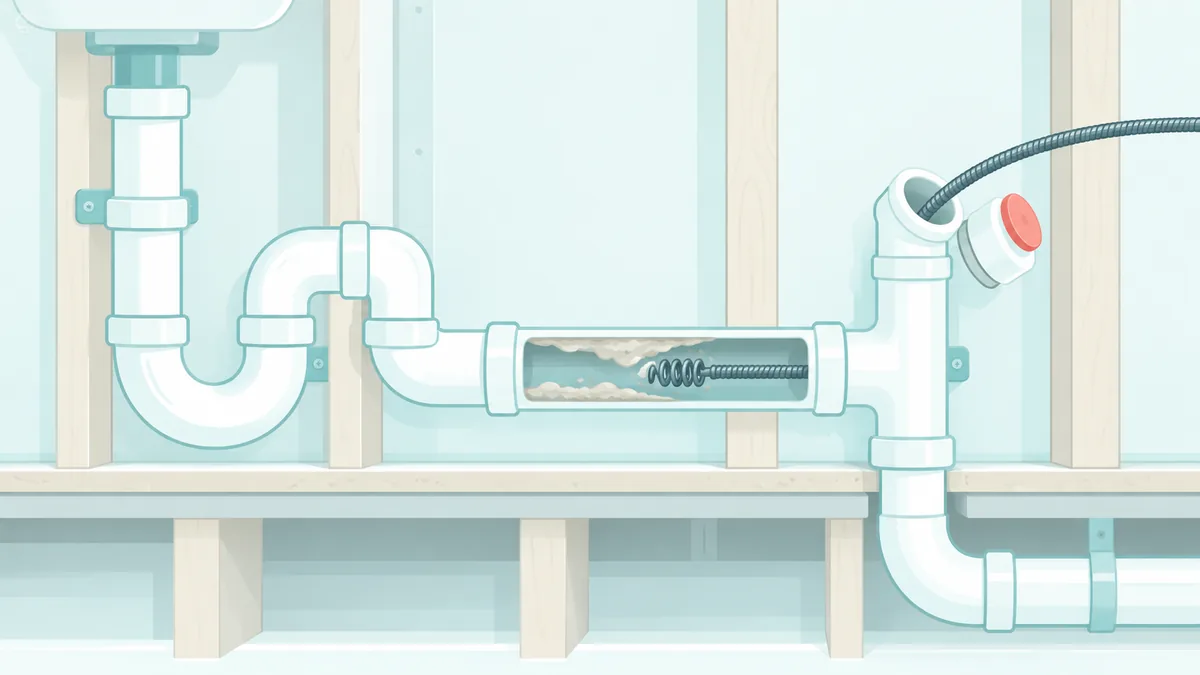
The answer to how to unclog a blocked pipe changes once the problem is no longer in the trap under the sink and has reached the drain pipe running through the wall and floor. Taking the trap apart and cleaning it is not enough at that point, because the sludge, grease or foreign object has built up a few metres further along, at a bend or where the pipe joins the main line. Most drain lines in homes are made of grey PVC pipe, while older buildings still use cast iron. The two materials block in different ways and are cleared with different methods.
This guide focuses on the pipe itself: why PVC and cast iron lines block, what to look for when choosing a drain snake, how to tell a gradient fault, and who is responsible when the building's shared drain pipe is blocked. We also touch briefly on limescale in hot water pipes, because that is a separate job belonging to the clean water plumbing. We explain the steps you can safely try at home, the situations where those steps will not be enough, and the point at which you should stop forcing it.
Why do drain pipes block?
Drain pipes mostly block because of residue that builds up slowly inside, while sudden blockages usually come from something that was put down the drain by mistake. The pipe material and the way it was laid decide how fast this build-up happens.
Grease and soap layers
Grease that leaves the kitchen warm cools inside the pipe and sticks to the wall. As soap residue and limescale add to it, the layer thickens and the inner diameter of the pipe narrows without being noticed.
Insufficient or reversed gradient
Horizontal PVC pipes need to be laid with a slight fall in the direction the water flows. If the fall is too small, the water slows down and drops the solids it carries. With a reversed gradient, water waits at one point and sludge keeps collecting there.
Rust and scaling in cast iron pipe
The inner surface of cast iron pipes in older buildings rusts and becomes rough over time. Hair and sludge cling to these rough patches. A cracked cast iron pipe can also leak and let odours out.
Foreign objects caught at bends
Wet wipes, cotton wool, sanitary pads and dental floss do not break down in water. They snag at the bends where the pipe changes direction, and everything that follows catches on them and makes the blockage bigger.
The building's shared stack
In apartment buildings every flat connects to the same vertical drain pipe. A blockage at the bottom of the stack or at the building outlet affects the lowest floors first, no matter which flat caused the problem.
Roots and collapse in the outdoor line
In older lines running through the garden, tree roots enter at the joints. Settling ground or a load above can also crush the pipe and cut off the flow.
How can you tell the problem is in the pipe and not the trap?
If water still drains slowly after you have cleaned the trap, the blockage is most likely in the pipe inside the wall or floor. The following signs back up that guess.
Drains on the same line slow down together
If the bathroom washbasin and the shower run slowly at the same time, the shared pipe they both connect to has narrowed. A problem that stays in a single drain is usually just below that drain.
Gurgling and air bubbles
If a drain makes a noise or bubbles when water is used somewhere else, water is being held back inside the pipe and air is being pushed back.
Slow drainage despite a clean trap
You took the trap off and cleaned it, put the seals back, but the flow did not improve. In that case the blockage is in the section of pipe after the trap.
Damp and smell at the foot of the wall
A damp patch on the wall the pipe runs through, plaster that blisters or a constant sewer smell can point to a crack or a leaking joint, especially in cast iron lines.
Water rising on lower floors
If dirty water comes up through the floor drain or shower on the ground floor or in the basement, the blockage is in the building's shared line and cannot be solved by one flat acting alone.
Methods for clearing a blocked pipe at home
Access to the pipe inside the wall is limited, so what you can do at home is fairly clear. Tried in the right order, these methods clear many blockages that are close by. For a blockage far along the line or in the shared line, they only help you work out where the problem is.
Check the trap and the pipe opening
This is the first step if a single washbasin, sink or shower drains slowly and you want to see where the problem starts.
- Put a bucket under the trap and lay towels around it.
- Undo the trap nuts by turning them by hand. If you need pliers, wrap the plastic in a cloth so it does not crack.
- Check inside the trap and the pipe opening where it enters the wall, and remove any hair and sludge.
- Make sure the seals are in place and undamaged, then refit the trap, tightening it by hand again.
- Run the tap and watch the flow. If water is still slow with a clean trap, the blockage is in the pipe inside the wall.
Overtightening the nuts crushes the seal and causes leaks. If you have poured a chemical drain opener into the drain before, do not open the trap, because the liquid inside can harm your skin and eyes.
Clearing with a drain snake
Suitable when the blockage is within the first few metres after the trap, in a PVC line serving a single drain.
- For washbasin and shower lines, choose a hand snake with a thin cable and a drum. The tip of the cable should be a coil or spring shape.
- Put on gloves, take off the trap and feed the cable in directly from the pipe opening in the wall.
- When the cable meets a bend or the blockage, turn the drum clockwise and advance it slowly.
- When the resistance eases, work the cable back and forth a few times, then pull it out while turning, and clean off what is on the tip.
- Refit the trap and run warm water from the tap for a while to flush the line.
Do not force the cable. At a bend it advances as you turn it and buckles as you push it. Snakes fitted to a drill can strain the joints in thin PVC pipes, so start with the hand type. Do not put a bare metal snake into the porcelain bend of a toilet, as it scratches the glazed surface.
Applying pressure with a plunger
Works when the blockage is right next to the drain and is soft build-up, for example in a shower drain or at a washbasin outlet.
- If the washbasin has an overflow hole, block it tightly with a wet cloth, otherwise the pressure escapes there.
- Leave enough water over the drain to cover the rubber cup of the plunger.
- Seat the plunger fully over the drain and push and pull repeatedly without letting air escape.
- Lift the plunger away quickly on the last pull and see whether the water goes down. Repeat a few times if needed.
Do not use a plunger on a drain that has had chemical opener poured into it, as the pressure can splash the chemical into your face. With a blockage in the shared line, a plunger only pushes the water into another drain or down to a lower floor.
Dissolving grease with hot tap water and detergent
You can try this if the kitchen line has slowed down over time and you think the cause is a grease deposit.
- Empty the standing water from the sink and put a little washing-up liquid into the drain opening.
- Run the hottest water from the tap slowly down the drain for a few litres.
- Watch how the water goes down. If the flow eases, repeat the same process once more after a while.
Tap water is enough. Do not pour water boiled on the hob into a PVC pipe, as it can soften the joints and seals. With a thick grease blockage this method eases the flow a little but does not dissolve the blockage completely.
Light residue cleaning with baking soda and vinegar
Can be used if the water has not stopped completely, the flow has only slowed, and the cause is soap or a light grease residue.
- Pour half a glass of baking soda into the drain opening.
- Add a glass of vinegar on top and cover the drain opening with a cloth.
- Wait until the fizzing stops, then run warm water from the tap.
This mixture is mild. It does not dissolve wet wipes, cotton wool or a solid object, and it has no effect on scale that has built up in a distant cast iron pipe. Do not add it to a drain that has had chemical opener used in it.
If hot water has weakened, check the aerator first
Start with this step if the problem is not in the drain but in the hot water coming from the tap getting weaker. This is a separate matter belonging to the clean water line.
- Unscrew the aerator at the tap tip by hand, or wrapped in a cloth.
- Clean off limescale and grains of sand with an old toothbrush, and if the scale is thick, leave it to soak in vinegar and water for a while.
- Refit the aerator and open the hot and cold water separately to compare the flow.
If the flow stays weak only on the hot side, the problem is in your water heater or in limescale in the hot water pipe. That is a different plumbing job from drain clearing. Do not take pipes apart yourself on a pressurised water line.
What to avoid when a pipe is blocked
Pouring boiling water
Water boiled on the hob softens the joints of a PVC pipe and upsets how the seals sit. Hot water from the tap is enough to loosen grease.
Using chemicals one on top of another
Pouring another opener on top because one product did not work can release dangerous gas and cause splashing. In old cast iron pipes, chemical left sitting also eats away at the pipe from the inside.
Forcing it with a wire coat hanger
A wire hanger bends at the bend, scratches the inner surface of the pipe and sometimes stays inside. A piece that breaks off makes the blockage even bigger.
Carrying on using water while the shared line is blocked
Running the washing machine or dishwasher pushes the water waiting in the stack up through the drains on the lower floors. Keep water use to a minimum until the problem is solved.
Going down into a manhole
Do not open the cover of a manhole in the garden or in front of the building and climb in. Sewer gas can cause loss of consciousness within a short time.
Breaking into the pipe without knowing where the problem is
Breaking tiles or walls before the location of the blockage is known causes needless damage. When the pipe is inspected with a camera, there is often no need to break anything at all.
When should you call a plumber for a blocked pipe?
If water rises from more than one drain at the same time, if the kitchen gurgles while water is used in the bathroom, or if the blockage returns within a few weeks, there is nothing more to be done at home. These signs show the blockage is far from the trap, in the main line of the home or in the building's shared stack. Dirty water coming from the floor drain on the lower floors and a persistent smell from the stack mean the same thing. If you have poured chemical into the drain without result, stop trying and tell the plumber who comes.
If the building's shared drain pipe is blocked, tell the management first. Let them know which floors and which drains are affected, how long the problem has been going on, and send a photo of any overflow if you have one. This information helps find the location of the blockage faster. For work on the shared line the management makes the decision, while a problem in a flat's own connection belongs to the flat owner. A blockage that keeps returning in old cast iron pipes can show that the pipe is scaling up or cracking inside. In that case the decision to replace it should be made by looking at the camera footage.
How do we clear a blocked pipe?
When the Cantley team arrives at the address, it first looks at which drains are affected and, if needed, sends a camera into the pipe. The footage shows the exact location of the blockage, the pipe material, any gradient fault, and whether there is a crack or a collapse. We show this footage to you and, if necessary, to the building management, and explain what needs to be done. The blockage is cleared with a motorised drain snake or a robotic machine. In lines where grease and sludge coat the pipe wall, we clean with high-pressure water jetting.
With these methods the work is done without breaking or digging, and there is no need to remove tiles or open walls. If the camera shows that the pipe is broken, crushed or has a faulty gradient, we recommend PVC pipe replacement or line renovation for that section only. In old cast iron lines, which part needs replacing is also decided from the footage. In buildings where sewage is pushed back at the building outlet, fitting a backflow valve protects the lower floors. We work 24/7 in all 39 districts of Istanbul.
How to stop pipes blocking again
- Do not pour frying oil or the grease left in pots down the drain. Let it cool, then put it in a container and throw it in the bin.
- Do not flush wet wipes, cotton wool, sanitary pads or dental floss down the toilet, and keep a lidded bin in the bathroom.
- Use strainers in sink, washbasin and shower drains, and clear the hair and crumbs that collect on them often.
- Once a month, run hot tap water with detergent through the kitchen line.
- When a new PVC line is laid during renovation, have the gradient checked and make sure an access point is left in.
- In apartment buildings, plan regular maintenance of the shared stack and the building outlet together with the management.
- In old cast iron lines, have the condition of the pipe checked with a camera when slow drainage starts to repeat.
Frequently asked questions
Which drain snake should I buy?
For home use, a hand-turned snake with a drum and a coil-shaped tip meets most needs. Choose a thin, flexible cable for washbasin and shower lines and a thicker one for wider lines. Drill-driven models are powerful but can strain the joints in thin PVC pipes if used carelessly. For a toilet, use a special sheathed toilet auger.
The building's shared drain pipe is blocked. Who should deal with it?
Because the shared drain pipe counts as a common part of the building, the building management arranges to have it cleared. Turkey's Condominium Ownership Law (Kat Mülkiyeti Kanunu) shares the costs of common areas between the flat owners, and the details are set by your management plan. A blockage in the connection inside your own flat is your responsibility. You will speed things up by telling the management which floors are affected, when the problem began, and by sending a photo of the overflow.
How do you clear a blocked hot water pipe?
A blockage in a hot water pipe is different from a drain blockage and comes from limescale building up in the clean water line. First take off the aerator at the tap tip and the shower head and clean the scale from them. If the flow stays weak only on the hot side, the problem is in the water heater or in scale inside the pipe. That is a separate plumbing job requiring descaling or pipe replacement, and it is not done with drain clearing machines.
Can a blocked pipe be cleared without breaking anything?
Yes, the great majority of blockages in drain pipes are cleared without breaking anything. The blockage is located with a camera, then a motorised drain snake, a robotic machine or high-pressure water enters the pipe through the drain opening or an access point. Breaking is only considered if the pipe has collapsed or broken. Even then, thanks to the camera, only the faulty section is opened.
Why does a PVC pipe block so often?
The most common reason a PVC pipe blocks often is an insufficient gradient or a faulty joint. When water flows slowly it drops the grease and solids it carries, and the deposit keeps growing at the same point. In lines where more bends than necessary were used, sludge also catches in the curves. If the blockage returns soon after being cleared, the gradient and the joints should be checked with a camera.
Should an old cast iron pipe be replaced?
A cast iron pipe should only be replaced if the camera footage shows a crack, a hole or advanced rust. Cast iron lines that are scaled on the inside but sound can be cleaned with high-pressure water and kept in use. Persistent damp at the foot of the wall, a smell from the stack and blockages that repeat at short intervals are signs that replacement is needed.
Can I pour chemical drain opener into a blocked pipe?
We do not recommend pouring chemical drain opener into a pipe blocked inside the wall. The chemical sits in the pipe without reaching the blockage, eats away at old cast iron pipe, can damage PVC joints and can splash onto your skin when the trap is opened. Mixing different products can release toxic gas. If you have already poured in a chemical, be sure to tell the plumber who comes.
Other guides
How to Clear a Blocked Toilet
What to do first if the water is rising, how shared lines work in a building, and when to call a professional.
Read the guideHow to Unclog a Toilet Bowl
How to use a plunger, whether toilet drain openers are safe, and what happens when an object falls into the toilet.
Read the guideHow to Unclog a Bathroom Sink
Trap cleaning, drain snakes, and baking soda with vinegar: which one works and when.
Read the guideHow to Unclog a Kitchen Drain
The sink is blocked and the water won't drain: steps for grease build-up and the dishwasher drain.
Read the guideHow to Unclog a Shower Drain
Hair build-up, smells and pooling water in the shower and floor drain.
Read the guideHow to Unclog a Balcony Drain
How to safely clear a balcony drain blocked by leaves and soil.
Read the guideHow to Unclog a Drain
The first minutes after a drain blocks: which line it is, what clears it and when to call.
Read the guideIf your pipe is blocked, contact us
If the blockage is beyond the trap or affects more than one drain, call 0212 923 66 85 or write to us on WhatsApp. Our team comes to the address, inspects the pipe with a camera, explains the situation and clears the blockage without breaking anything.