How to Unclog a Shower Drain
To unclog a shower drain, first lift the grate and remove the visible hair and soap scum with a gloved hand, then take out the odour trap cup and rinse it in warm water. If the water still drains slowly, use a plunger that fits snugly over the drain, and if needed clear the first stretch of pipe with a thin drain snake. If water rises in several drains at once, the problem is in the building's shared line.
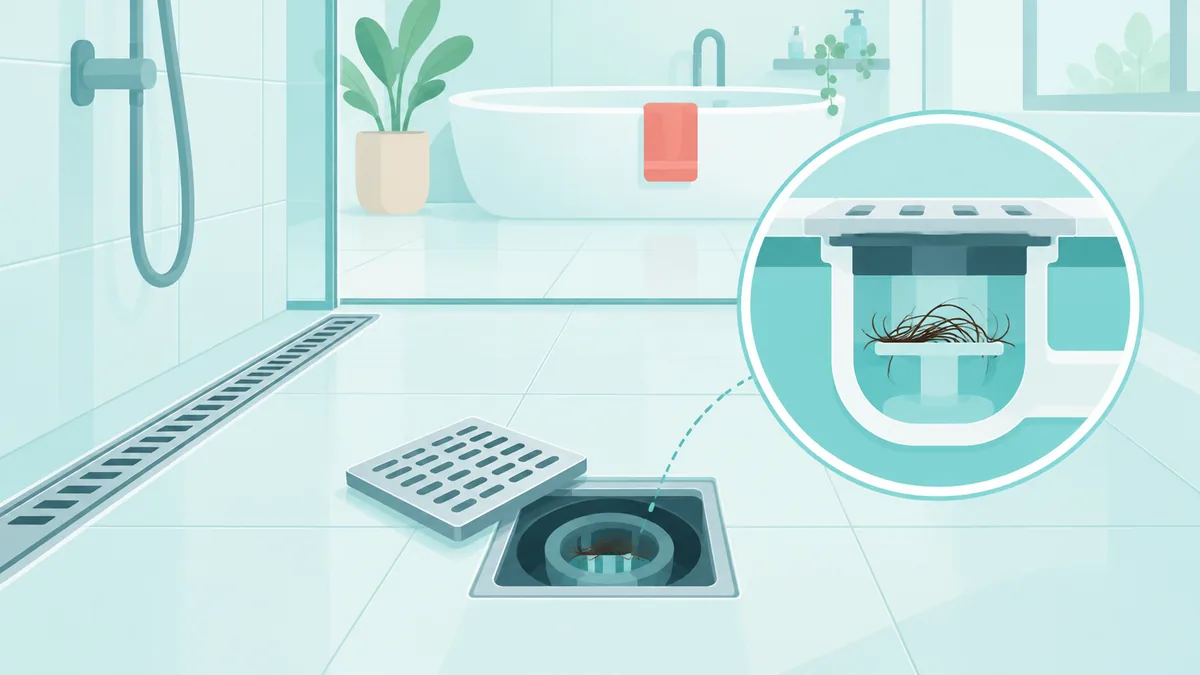
For most people searching for how to unclog a shower drain, the problem is waiting just a few centimetres below the grate. The most common reason water drains slowly from a shower tray, floor drain or bath is that strands of hair bind with soap and shampoo residue into a felt-like clump. This clump usually collects inside the odour trap cup or right at its outlet. That means you do not have to wait for a plumber to make a first attempt: a pair of gloves, an old toothbrush and a little patience can get the water moving again.
Still, not every bathroom drain is built the same way. Round floor drains have a removable plastic cup under the grate. In long linear shower channels the strainer runs along the floor and dirt spreads across the bottom of the channel. In a bath, the plug mechanism and the overflow opening change the job a little. This guide covers, in order, the steps for each type of drain, the mistakes to avoid, and the signs that the blockage is coming from the building's shared line rather than from inside your home.
Why does a shower drain get blocked?
A shower drain usually clogs gradually, from small deposits that build up over weeks. Knowing what has built up helps you choose the right method.
Hair and soap clumps
Hair shed in the shower would normally wash away easily on its own. When the oily substances in soap and shampoo glue the strands together, a tight plug forms inside the cup, and the water first slows down and then stops.
Limescale and cosmetic residue
Hard Istanbul water combines with conditioner and body oils and leaves a thin crust on the inside of the pipe. This crust narrows the pipe and creates a rough surface for hair to catch on.
Small objects that fall into the drain
Shampoo caps, razor guards, cotton buds, dental floss or children's bath toys can slip in past the edge of the grate. They catch at the bend and start to trap other debris.
Renovation and grout debris
Grout filler, plaster or cement water that gets into the drain after tiling hardens at the bottom of the pipe. This kind of blockage will not be cleared by a plunger or baking soda, and it usually needs a machine.
The building's shared line
Your shower drain connects to the building's vertical shared stack. A blockage in the stack or in the main line in the basement makes water come back up through the bathroom, especially on lower floors.
Signs that your shower drain is blocked
A complete blockage usually comes after some warning. Acting as soon as you notice one of these makes the job easier.
Water pools around your feet in the shower
If water is not leaving the shower drain or leaves very slowly, you are left with a pool in the tray or on the floor after the shower. This points to a narrowing in the cup or in the first metre of pipe.
The drain gurgles
A bubbling or gurgling sound from the drain while water runs means air is being trapped in the pipe. A partly blocked line cannot pass water and air at the same time.
There is a bad smell in the bathroom
In a bathroom that has not been used for a long time, the water in the odour trap evaporates and sewer smell rises into the room. In a bathroom that is used every day, the smell usually comes from hair and soap scum rotting inside the cup.
Water comes up from another drain
If water rises from the floor drain while the sink or washing machine empties, the pipe beyond the point where the two drains join is blocked. In that case cleaning the grate is not enough.
The floor grout is turning dark
If water stays on the floor without reaching the floor drain, darkening and mould start in the grout. Sometimes this is caused by a blockage, and sometimes by a floor that does not slope enough towards the drain.
Ways to unclog a shower drain at home
Try the methods in order: the first two clear most blockages. Before you start, put on rubber gloves and ventilate the bathroom.
Lifting the floor drain grate and cleaning the odour trap
This is the first method to try if the water drains slowly, you can see hair between the grate bars, or there is a slight smell in the bathroom.
- Lift the grate from its edge with your fingernail or the tip of a flat screwdriver. If it is screwed down, remove the screws and put them in a container so they do not get lost.
- Take out the visible hair and soap scum with your gloved hand and drop it into a bag. Do not push it back into the drain.
- Remove the odour trap cup underneath by pulling it upwards or turning it slightly.
- Scrub the cup with warm soapy water and an old toothbrush in a bucket, not in the sink.
- Clean the part of the drain opening that you can see with the brush as well, then refit the cup so that its seal sits properly.
- Pour a bucket of warm water in slowly to check that the water runs freely, then put the grate back.
Do not forget to refit the cup after taking it out: without the odour trap, sewer gas comes straight into the bathroom. A cup with a cracked or missing seal causes the same smell.
Cleaning a shower tray and a long shower channel
If you are wondering how to unclog a shower drain and the problem is in the shower tray or in the linear channel running along the floor, these steps will help.
- Remove the round strainer cover in the shower tray by turning it anticlockwise or lifting it up.
- In a long channel, hold the stainless steel grate at both ends and lift it, then collect the hair and sediment from the bottom of the channel with a plastic spoon or spatula.
- Take out the outlet cup at one end of the channel, clean out what is inside it and rinse it in warm water.
- Push a toothed plastic hair-removal strip, sold in hardware shops, into the drain opening and pull it back slowly to bring out the hair that has caught on it.
- Refit the cup and the grate, then rinse the whole length of the channel with warm water from the shower head.
Do not push the plastic strip forward with hard movements: you may compress the hair clump deeper. Use plastic tools rather than metal ones, which can scratch a stainless steel channel.
Using a plunger to apply pressure
If the cup is clean but the water still drains slowly, the blockage is a little further along the pipe, and a plunger will often shift it.
- Remove the grate and the cup so that the rubber part of the plunger sits fully over the drain opening.
- Leave a few fingers' depth of water in the tray or on the floor, enough to cover the rubber: it is water, not air, that carries the pressure.
- If you are working on a bath, block the overflow opening tightly with a wet cloth, otherwise the pressure escapes through it.
- Hold the plunger upright and push and pull firmly but in a controlled way fifteen to twenty times, lifting the rubber off quickly on the last pull.
- If the water drains away, flush the line with a bucket of warm water. If not, repeat the process two or three times.
Do not use a plunger if you have poured a chemical drain opener into the drain: product splashing up under pressure can seriously harm your eyes and skin. On square floor drains it can be hard to get the rubber to seal, and if air escapes around the edges the method will not work.
Clearing the first metres of pipe with a drain snake
If the plunger did not work, or you suspect an object has fallen into the drain, a thin hand-operated snake can reach the first few metres of pipe.
- Remove the cup and lay an old towel under the drain opening.
- Feed the flexible snake in slowly. When you reach a bend, turn the handle to move forward instead of pushing.
- Where you feel resistance, turn the snake a few times so that its tip grips the blockage.
- Pull the snake back slowly and wipe the dirt caught on its tip straight into a bag.
- Rinse the line with plenty of warm water and check how the water flows.
Never force the snake: the gasketed joints of old pipes can come loose. If the snake suddenly spins freely or will not advance, stop, because the blockage is further away than a hand snake can reach.
Unclogging a bath drain through the plug mechanism
If the bath empties slowly, the problem is usually hair that has collected under the plug cover, where it meets the overflow pipe.
- Unscrew a push-type plug cover by turning it anticlockwise while it is in the open position. On lever models, open the overflow cover and pull the mechanism upwards.
- Clean the hair wrapped around the cover body and the mechanism with a gloved hand, and rinse the parts in warm soapy water.
- Bring out the debris you can see through the opening with a plastic hair strip.
- Refit the parts, then fill the bath a finger deep and let it empty to check the flow.
When removing and refitting the mechanism, do not lose the seals and do not overtighten the screws: water leaking under the bath is often caused by a badly seated seal.
Surface cleaning with baking soda, vinegar and warm water
This mixture helps if the water runs a little slowly but is not fully blocked, or if you want to remove the thin film of soap in the pipe after cleaning the cup.
- Empty the water at the drain opening and pour half a glass of baking soda straight into the drain.
- Add a glass of vinegar on top and cover the grate with a cloth until the fizzing stops.
- Leave the mixture for about half an hour.
- Then flush the line with two or three litres of warm tap water.
This mixture is a mild cleaner: it will not dissolve a hair clump, hardened grout filler or an object that has fallen in. Do not use boiling water to rinse, because the joints of PVC pipes can soften and start to leak.
What not to do when unclogging a shower drain
Pouring in boiling water
Most bathroom lines are PVC pipe, and boiling water softens the seals at the joints. Hot water from the tap is enough.
Relying on a chemical drain opener
Chemical drain openers do not always dissolve a hair clump, and by sitting in the pipe they can damage PVC and the seals. If you have used one and the blockage continues, be sure to tell the technician you call.
Mixing different products
Pouring bleach into the same drain as hydrochloric acid, a descaler or another drain opener releases toxic gas. Because a bathroom is a small, enclosed space, the risk is even greater.
Poking around with a wire hanger or a knife
An unbent coat hanger scratches the inside of the pipe, breaks the edges of the cup and sometimes gets stuck inside. Use a flexible snake with a soft tip.
Removing the odour trap and throwing it away
Some people leave the cup out so that the water drains faster. This opens the door for sewer smell and small insects to enter the bathroom.
When should you call a professional?
If you have cleaned the cup and tried the plunger and the snake but the water still does not drain, the blockage is somewhere hand tools cannot reach. Water rising from the floor drain when the sink is emptied, gurgling in the shower tray when the toilet is flushed, or several drains in the home slowing down at the same time, all show that the problem is in the shared line and not in the bathroom's own pipe. If the same drain blocks again every few weeks, there is a limescale crust or hardened renovation debris inside the pipe.
If you live on a lower floor and dirty water is coming back up in your bathroom, do not wait, and let the building management know as well: a blockage in the shared stack affects the whole building. It is also safer to leave the job to a crew if the water is still standing after you poured a chemical into the drain, if there is a heavy sewer smell in the bathroom that does not go away, or if you see signs of a leak under the floor.
How do we unclog a shower drain without breaking tiles?
When the Cantley team arrives at your address, it first listens to the problem and checks which drains are affected. If needed, it sends a camera in through the drain opening and shows you the inside of the pipe on the screen, so it becomes clear whether the blockage is at the cup outlet, at the bend under the floor or at the connection to the shared stack. We explain what will be done before the work begins.
For hair and soap scum, the inside of the pipe is cleaned with a motorised drain snake or a robotic machine. For limescale crust, hardened grout filler and deposits in the shared line, the line is flushed with high-pressure water jetting. All of this is done through the drain opening or through the manhole, so the work is completed without breaking tiles or opening the floor. When the job is done, a final CCTV drain camera check is made and you can see together that the water flows freely.
How to keep your shower drain from blocking again
- Place a fine-holed silicone strainer that catches hair over the floor drain and the bath, and throw the hair on it into the bin after every shower.
- Once a month, lift the grate and wash the odour trap cup in warm soapy water.
- Once a week after a shower, pour a bucket of warm water down the drain to slow the build-up of soap film in the pipe.
- In rarely used bathrooms such as a guest bathroom, pour water down the drains once a week so that the odour trap does not dry out.
- During a bathroom renovation, ask the workers not to pour grout and cement water down the drain, and cover the grate with tape while they work.
- Always throw cotton buds, dental floss, razors and small wrappers in the bin: they should go neither down the drain nor into the toilet.
Frequently asked questions
What should I do if water does not drain from my shower drain?
First lift the grate, take out the odour trap cup and clean the hair and soap scum inside it; most blockages are cleared here. If the water still stands, leave a few fingers of water over the strainer and use a plunger, then try a thin drain snake. If these do not work and water is also rising from other drains, the problem is in the shared line and needs to be cleared with a machine.
How do you unclog a shower drain?
A shower drain is unclogged by turning the strainer cover to remove it and cleaning the cup underneath. In long shower channels, lift the grate, collect the hair at the bottom of the channel with a plastic spatula and rinse the outlet cup. Bring out the clump at the opening with a plastic hair-removal strip, then rinse with warm water. If water still collects after these steps, you can try the plunger and then the drain snake, in that order.
Why does a shower drain smell bad?
A shower drain smells most often because the water in the odour trap has dried out. In rarely used bathrooms this water evaporates and sewer air rises into the room, and pouring a bucket of water in often stops the smell. In a bathroom that is used often, the smell comes from hair and soap rotting inside the cup. A smell that does not go away after cleaning points to a cup without a seal or to a problem with the stack ventilation.
Can you pour boiling water down a blocked shower drain?
No, do not pour boiling water down a blocked shower drain. Bathroom pipes are mostly PVC, and boiling water can soften the seals at the joints and cause leaks. Hot water from the tap is enough to soften the soap film. If the water is not draining, hot water will not clear the blockage either: clean the cup first, then try the plunger and the drain snake.
Can you pour a chemical drain opener down a shower drain?
You can, but it is not recommended. It often does not dissolve a hair clump, it can damage PVC and the seals by sitting in the pipe, and if the blockage continues a dangerous liquid collects in the drain. If you have used one, do not use a plunger, do not add any other product, and tell the technician who comes which product you poured. Cleaning the cup by hand is much safer and more effective.
How do you unclog a bath drain?
A bath drain is unclogged by removing the plug cover and cleaning the hair wrapped around it. Push-type covers come off by turning them in the open position, and on lever models the mechanism is pulled out through the overflow opening. After you wash the parts and refit them, if the water is still slow, block the overflow opening with a wet cloth and use a plunger. If the plunger does not work either, a thin drain snake can be tried through the drain opening.
My bathroom drain is blocked: why does water come out of the floor drain when the sink empties?
If water comes out of the floor drain when the sink empties, the pipe beyond the point where the two drains join is blocked. The sink water cannot move on into the main line and comes back through the lowest outlet, which is the floor drain. In this case cleaning the grate does not solve the problem: the blockage is usually in the pipe under the floor or at the building's shared stack connection, and it needs to be cleared with a machine.
Other guides
How to Clear a Blocked Toilet
What to do first if the water is rising, how shared lines work in a building, and when to call a professional.
Read the guideHow to Unclog a Toilet Bowl
How to use a plunger, whether toilet drain openers are safe, and what happens when an object falls into the toilet.
Read the guideHow to Unclog a Bathroom Sink
Trap cleaning, drain snakes, and baking soda with vinegar: which one works and when.
Read the guideHow to Unclog a Kitchen Drain
The sink is blocked and the water won't drain: steps for grease build-up and the dishwasher drain.
Read the guideHow to Unclog a Balcony Drain
How to safely clear a balcony drain blocked by leaves and soil.
Read the guideHow to Unclog a Blocked Pipe
Blockages in PVC and old pipes, the shared drain pipe, and pipe-clearing attachments.
Read the guideHow to Unclog a Drain
The first minutes after a drain blocks: which line it is, what clears it and when to call.
Read the guideIf your shower drain is still blocked
If the methods you tried did not work, call 0212 923 66 85 or write to us on WhatsApp. The Cantley team comes to all 39 districts of Istanbul 24/7, shows you the problem on camera and unclogs your bathroom drain without breaking anything.