Published: 17 October 2026
In short
- If the pipe is sound and there is an access point, a blockage can be cleared without breaking tiles.
- The need to break out usually comes not from the blockage but from a collapsed, broken or separated pipe.
- The camera shows how far away the fault is and where it sits, so the area that is opened stays limited to a single spot.
- When you are told to break out, it is your right to see the footage and to ask what type of fault it is.
The phrase "without breaking" is sometimes used as if it were a cure for everything. Instead of making a firm promise on something nobody can know in advance, it is more honest to explain clearly what to expect in each situation. That way you know what you will hear before the team arrives at your door.
Which entry points are usually used to reach a blockage?
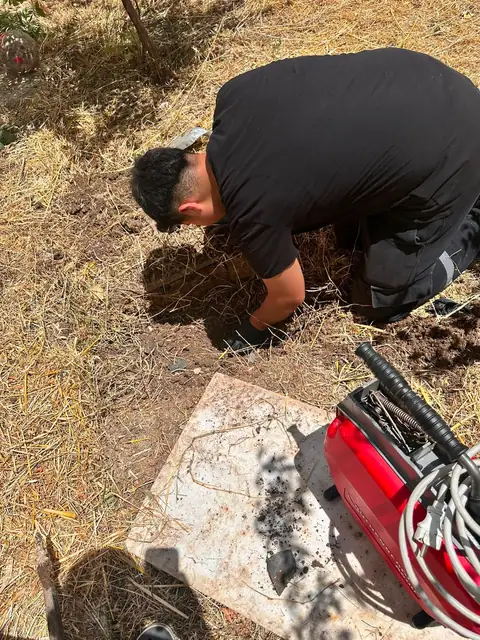
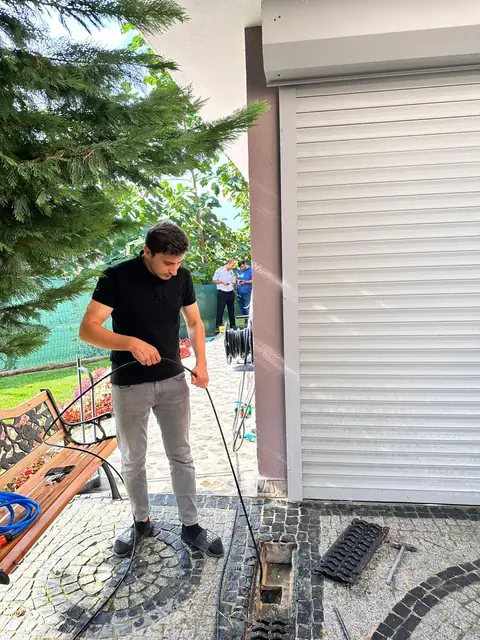
A building's drainage network has many more access points than people assume. The machine's cable and the camera enter through these points, following the path the water takes in reverse. Whichever pipe the blockage is in, the entry point that offers the closest and straightest route to it is chosen.
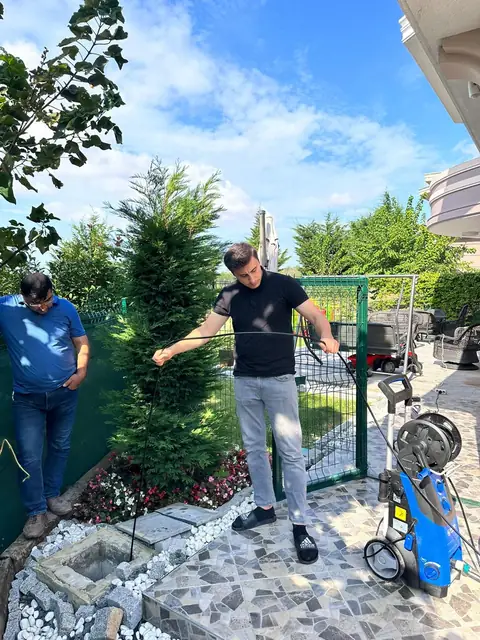
Most blockages sit a few metres past one of these entry points, as a build-up of grease, hair, wipes or sediment. As long as the pipe is sound, a drain snake, a robotic head or pressurised water removes the build-up and nothing needs to be broken.
- The openings of sink, shower and kitchen sink drains, and traps that can be unscrewed
- Screw-on or hinged cleaning points on shared stack pipes
- Manholes and inspection chambers in the garden, at the building entrance or in the car park
- Balcony and terrace floor drains
- The toilet connection, with the toilet removed by a plumber when necessary
Common misconceptions about no-dig unclogging
Some beliefs passed around by word of mouth lead homeowners either into needless worry or into needless renovation work. Here are the ones we hear most often, and what is actually the case:
- "Every blockage can be cleared without breaking anything." This is true as long as the inside of the pipe is sound and reachable. In a collapsed pipe, the machine finds no way forward.
- "If something has to be broken, the whole bathroom gets torn up." Once the camera shows the location of the fault, the area opened is usually limited to one or two tiles or a small piece of floor.
- "Pouring in chemicals is a substitute for breaking out." Chemicals do not repair a broken or collapsed pipe, and they also create a splash risk for the crew who have to work on the line afterwards.
- "Breaking out where the pipe is thought to run speeds things up." A hole made without footage often lands a few steps away from the actual problem rather than right on top of it, and a second hole is needed.
When does opening up one spot become unavoidable?
When breaking out is necessary, the reason is almost always not the blockage itself but a pipe that has been damaged. Both the machine and the water can only move through the inside of the pipe. If the pipe has lost its shape or its route, what can be done from the inside is limited.
In these cases the blockage can sometimes be cleared temporarily, but because the underlying fault is still there, the problem returns quickly. The lasting solution is to reach the faulty section and replace it.
- A collapsed or crushed pipe: the cross-section has closed and the cable cannot get past
- A joint that has broken and separated: water escapes outside the pipe and soil gets into it
- A hard object that has lodged in the pipe: it can be neither pulled out nor pushed through from the inside
- A line with no cleaning points at all, buried in concrete and full of tight bends
- A section whose gradient has been disturbed and which constantly holds water
How does the camera reduce the area to be broken to a single spot?
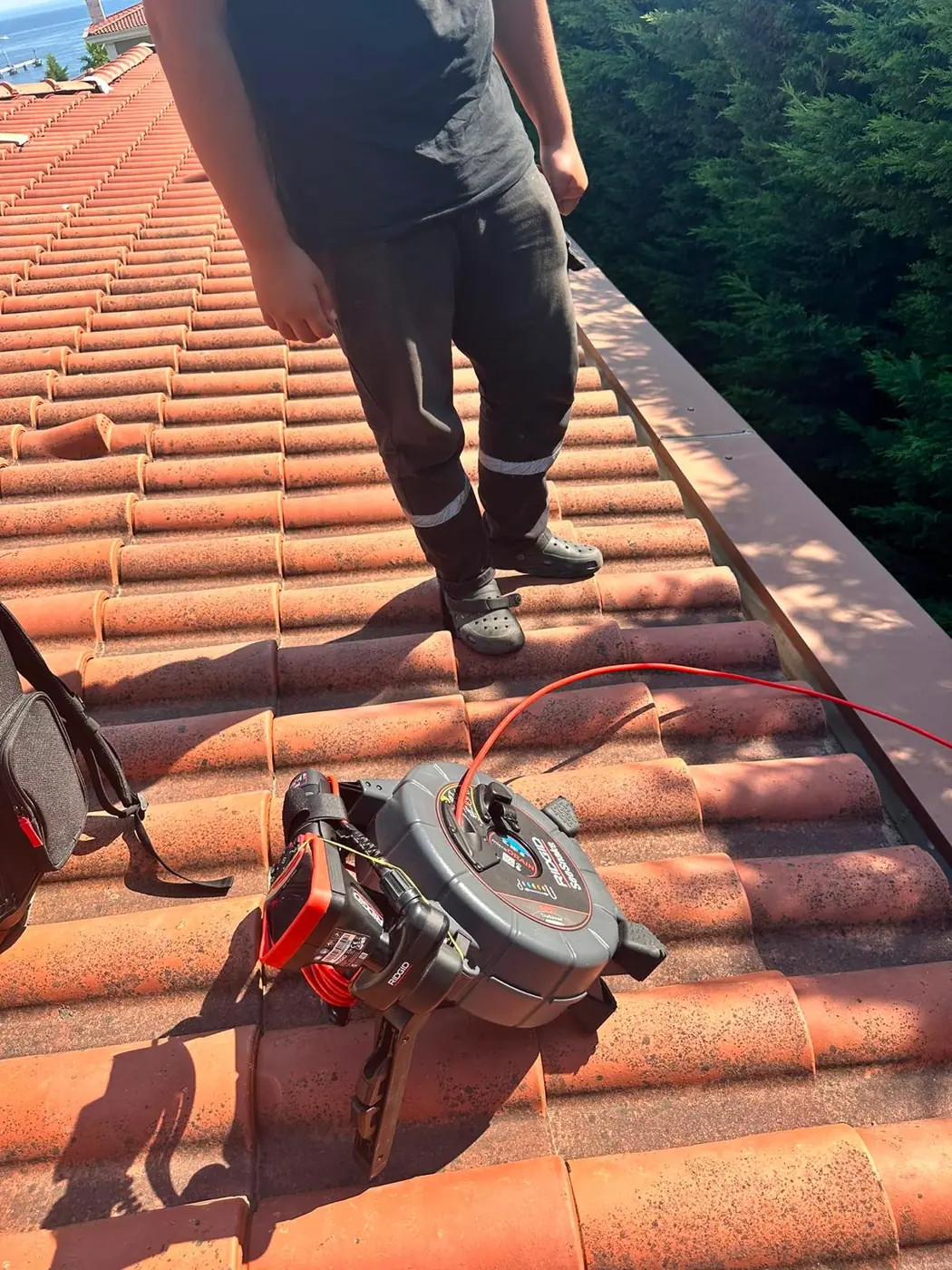
As the camera moves along the pipe, the length of cable fed in is measured. The moment the fault appears on the screen, that length gives the distance from the entry point. With the transmitter at the tip of some cameras, the exact position of the pipe under a wall or floor can be found from above with a handheld device, and the spot is marked.
This way the breaking is done directly above the point where the fault was seen, and only as much as is needed. Instead of the whole bathroom floor, often a single tile's worth of area is opened. After the part is replaced, the line is run through with the camera again and you can see on the screen that the problem has been fixed.
Why is it harder to reach the inside of pipes in older buildings?
In older buildings the plumbing was often laid out differently from today's standards. Stacks with no cleaning points, tight bends buried under plaster and pipe sections added in different periods slow the progress of the cable and the camera. In cast iron or old galvanised pipes, the layer of rust on the inner surface also narrows the cross-section and puts strain on the tip of the machine.
Even on such lines a way in from the inside can usually be found. It only takes choosing the right entry point and working patiently with thinner heads. If the pipe has rotted from within and can no longer support itself, however, forcing it makes the fault worse, and at that point replacing the section is the wiser decision.
Questions you can ask when you are advised to break out
When you are told that a spot needs to be opened, it is your right to find out what that is based on. Watching the footage together with the team makes the decision clear and leaves you with no lingering doubts.
- Was the fault seen on the camera, and can you show me the footage?
- Is the problem a material building up inside, or the pipe itself?
- How large will the area to be opened be, and exactly where?
- Was solving it from the inside through another entry point tried?
- After the part is replaced, is there any problem visible in the rest of the line?
What changes on a shared stack and the building line?
In apartment buildings, the shared stacks and the building line are usually fitted with cleaning points and manholes, so reaching the inside is often easier than in a single flat. A manhole in the basement or garden gives access to most of the building line. However, if these openings have been covered over, painted, or left behind a cupboard, they first have to be found.
If a spot on the shared line needs to be opened, the decision is usually made together with the building or site management. A camera recording makes this conversation easier, because the location and size of the problem rest on footage that everyone can watch.